2026-11-09
Stabilization or unauthorized rebuild: reading post-damage site changes
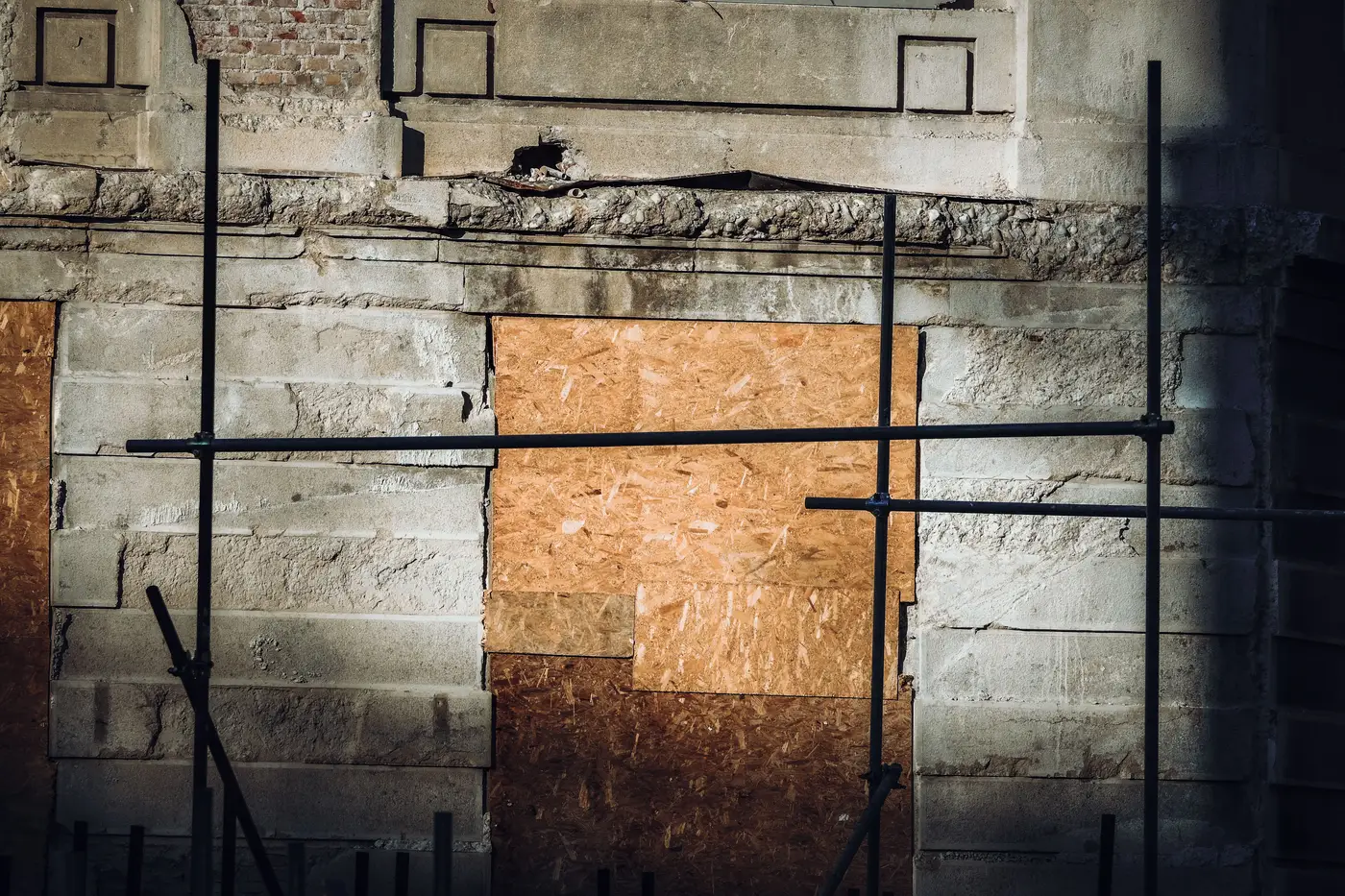
When a damage report comes in from a protected site, the clock on the response doesn't stop at "the roof is gone" or "the north wall is down." What happens in the following weeks matters just as much for the record, because not everything that goes up on a damaged structure is the same kind of event. Some of it is stabilization: props, bracing, sandbags, a tarp lashed over an exposed vault to keep weather out until a proper assessment can happen. Some of it is reconstruction that nobody authorized, sometimes done quickly to erase evidence, sometimes done by occupants who just want the building usable again. A documentation file that treats these as the same thing has a gap in it.
What emergency stabilization actually looks like on the ground
Stabilization is reversible by design. Steel props under a cracked lintel, timber shoring against a leaning facade, plywood over a blown-out window opening, a tarpaulin pulled across a collapsed roof section and weighted at the corners. It uses whatever's on hand locally and goes up fast, often within days of the strike, because the point is to stop further loss immediately. The footprint of the structure doesn't change. Materials are generic and visibly temporary: plastic sheeting, scaffold tube, sandbags, rather than matched stone or fresh mortar. If you're looking at imagery from the week after an incident and you see this kind of scaffolding or bracing appear against an otherwise unchanged ruin, that's the expected emergency response, and it should be logged as such rather than flagged as a change to the heritage fabric itself.
What unauthorized reconstruction looks like instead
Reconstruction reads differently once you know what to look for. New courses of masonry appear where the old wall ended. A roofline comes back in a different pitch or material from what was destroyed. Fresh concrete shows up where there was none before, sometimes extending the original footprint instead of restoring it. These changes typically surface weeks or months after the strike, built with purpose-bought materials: matched stone, fresh-mixed mortar, dimensional lumber bought specifically for the job.
Color and texture mismatches are common tells too. New stone that hasn't weathered. Mortar a different shade from the surrounding original work. A patched section that's noticeably more regular than the damage pattern around it. None of this is subtle once you have two dated images to set side by side. It's subtle only when the record you're working from is a single photo with no fixed date and no way to confirm what the site looked like immediately after the reported event.
Why the date on the image is the whole case
The distinction between stabilization and rebuild almost never comes down to what the structure looks like in isolation. It comes down to what changed, and when, measured against the date the damage was first reported. A photo showing scaffolding proves nothing on its own; a photo showing scaffolding dated three days after the strike, compared against a later frame showing new masonry dated six weeks on, is a sequence that holds up. That's the gap that tends to open up when a file gets built from whatever satellite frames happened to be public around the time: the before-and-after exists, but the middle is missing, and the middle is exactly where stabilization turns into something else or doesn't. Heritage Conflict Damage pulls event-driven VHR imagery tied to the reported date of an incident and returns a coordinate-stamped change record, so the sequence from strike to stabilization to whatever comes after is dated and tied to the same ground location throughout, rather than assembled after the fact from whichever frames are available.
If part of your job is telling investigators or a protection body what actually happened to a site after it was hit, and when, that's worth having on file before the question gets asked.